MotoGP lowside explained: what it is, how it happens and why it still changes…
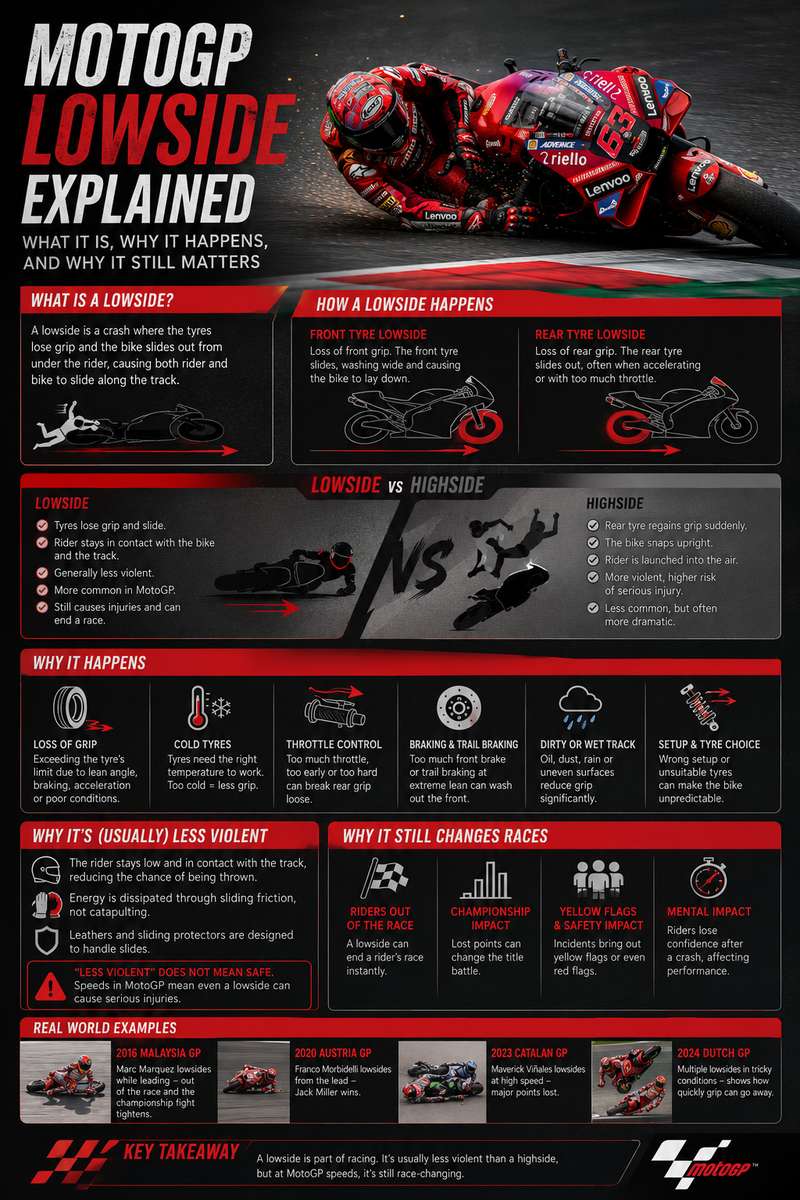
A lowside is one of the common crash types you’ll see in MotoGP corners. It happens when a tyre loses lateral grip while the bike is leaned over and the machine and rider slide toward the inside or "low" side of the turn. Lowsides are usually less violent than highsides, but they regularly end races, damage bikes and create secondary incidents.
A lowside occurs when either the front or the rear tyre loses lateral traction while the bike is leaned; the bike slides out and falls toward the inside. Front "washouts" (front tyre loss) and rear slips can both produce lowsides. Unlike a highside, a lowside involves sliding rather than a violent catapult, but it still changes race outcomes.
CLEAR DEFINITION
In MotoGP terms a lowside is a crash in a turn where a tyre—either front or rear—loses lateral grip while the bike is leaned over and the rider and machine fall and slide toward the inside of the corner. The bike ‘‘slides out’’ rather than launching the rider skyward.
HOW IT HAPPENS
Two common mechanical paths lead to a lowside. A front washout occurs when the front tyre suddenly loses lateral traction: the contact patch can’t hold the cornering forces, the forks ‘‘tuck’’ and the bike collapses down the inside. A rear-induced lowside happens when the rear slips laterally—often from too much drive, a cold or contaminated surface, or an abrupt change in traction—and the chassis rotates and drops onto the inside, producing a slide.
Track factors such as debris, oil, moisture or a cold tyre compound increase the risk. Rider inputs—over-aggressive braking, abrupt steering, or an untimely throttle—can trigger the loss of grip. Race electronics and rider technique aim to reduce these events, but lowsides still happen when grip limits are exceeded.
WHY IT MATTERS IN MOTOGP
Although less dramatic than a highside, a lowside is race-changing. Sliding into the gravel, run-off or barriers can cause retirement. A dropped bike needs recovery and repair, costing positions and laps. Lowsides can also create secondary incidents if a sliding machine crosses another rider’s line.
RIDER TECHNIQUE
Riders use smooth inputs to avoid triggering a lowside: controlled trail-braking, measured throttle roll-on, and precise steering. When a front washout begins, there is little to do—the front has already lost its lateral bite and the forks may tuck. For rear slides, prompt, calm corrective inputs and reliance on traction control systems can prevent a slide from developing into a crash or from snapping back into a highside.
BIKE BEHAVIOUR AND TECHNOLOGY
Tyre temperature and compound determine how much lateral force the contact patch can carry. Electronics—traction control and stability systems—help manage rear slip and reduce the likelihood of the sudden regain that causes highsides. However, these systems can’t always prevent a tyre from sliding when the physical grip limit is exceeded, and a slide will still result in a lowside.
COMPARISON: HIGHSIDE VS LOWSIDE
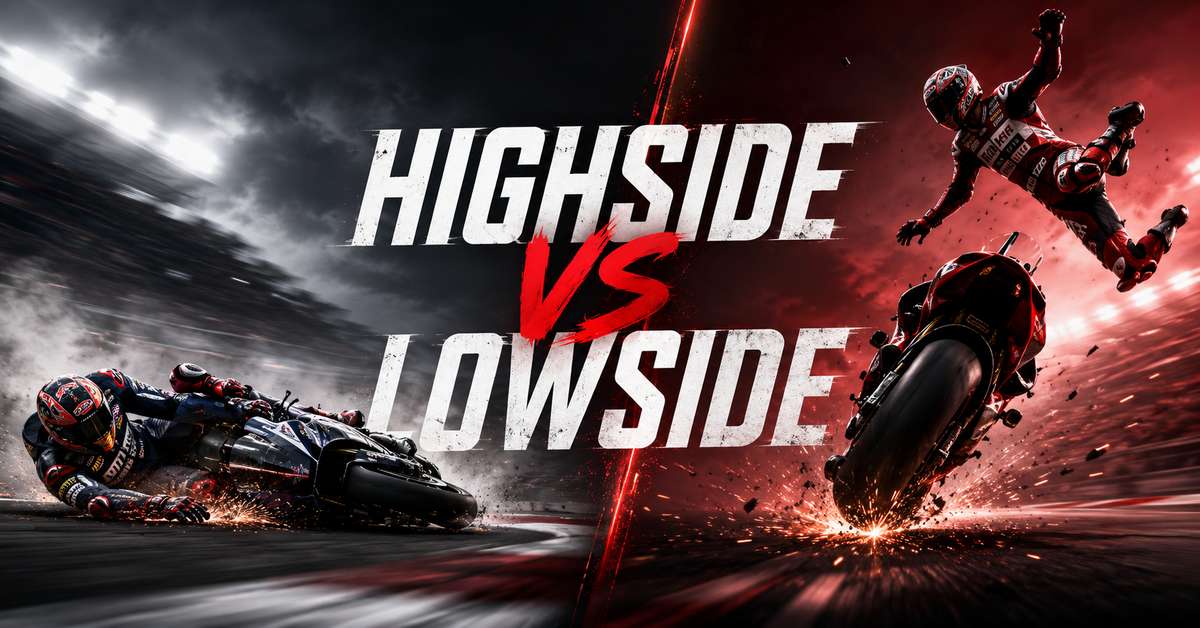
The essential difference is in the sequence and severity. A lowside is a loss of traction that results in sliding toward the inside and generally less violent contact with the track. A highside starts with a rear slip followed by a sudden regain of traction that violently rotates the bike and often throws the rider off—making highsides typically far more dangerous. MotoGP teams and technical staff reference electronics and stability control specifically to reduce highside risk.
SAFETY AND COMMON MISUNDERSTANDINGS
Beginners sometimes assume ‘‘less violent’’ means ‘‘minor consequence.’' In reality, sliding at race speeds can still cause serious injury, significant bike damage, and race elimination. Television slow-motion can hide how quickly a front washout develops; what looks like a small wobble is often the moment the contact patch exceeds its limit.
FAN VIEWING GUIDE
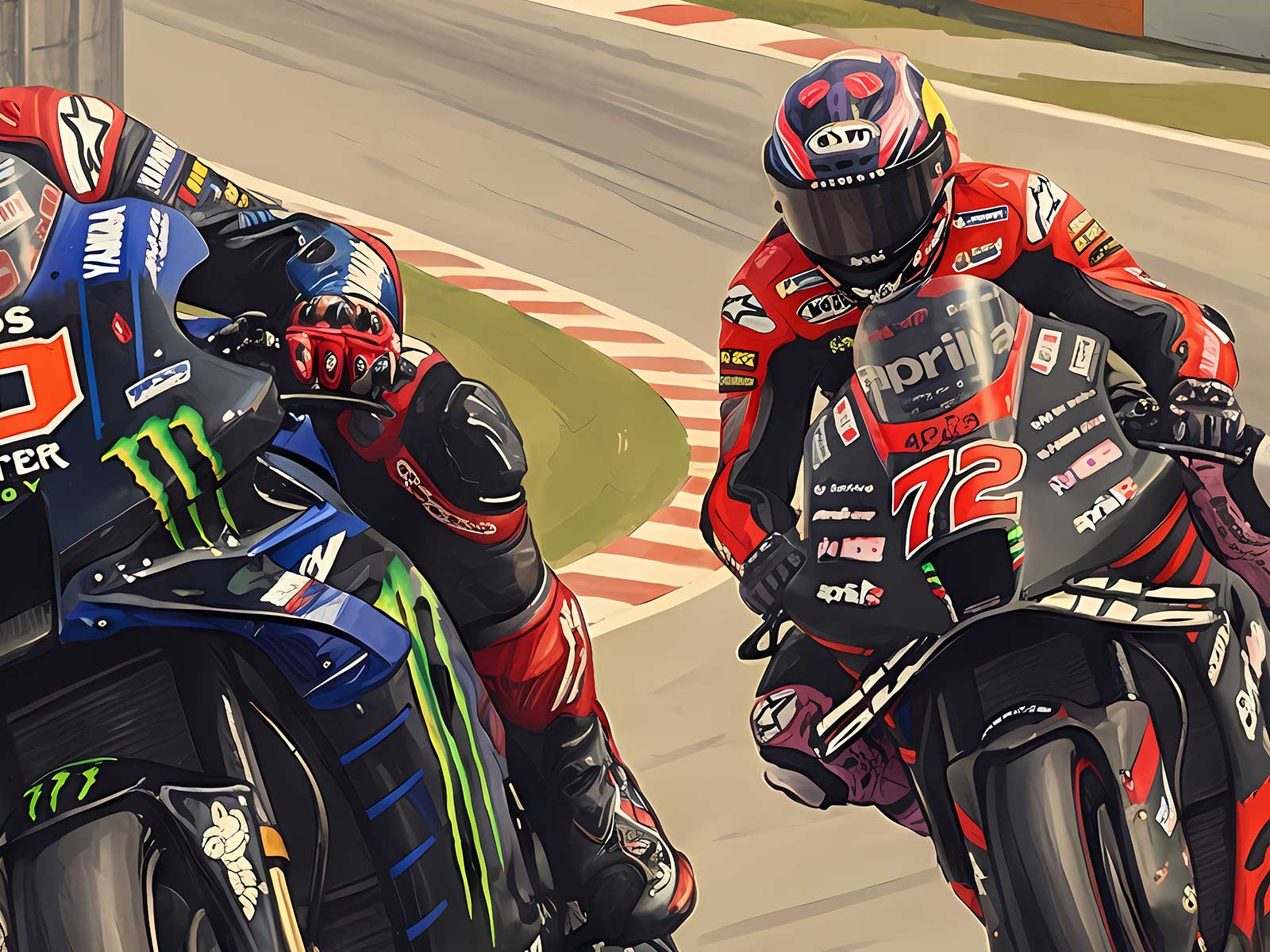
On screen, a lowside often looks like the bike folding down and sliding along the inside of a corner. A front washout will show the front compressing or collapsing; a rear lowside looks like the rear stepping out then the bike dropping. Recognising the slide early helps viewers understand why a rider suddenly loses place or retires even when no dramatic airborne crash occurs.
CLOSING INTERPRETATION
Lowsides are an unavoidable part of motorcycle racing: they expose the thin line between grip and slide at extreme lean angles. Understanding a lowside—its causes, the role of tyres and electronics, and the difference from a highside—gives fans clearer insight into why riders sometimes vanish from contention in a single corner. They are usually less violent but remain one of the clearest ways speed and tiny grip margins can decide a MotoGP weekend.
Author: Cynthia D.