What is a highside in MotoGP? — Explained
A highside is one of the most feared crashes in motorcycle racing: the rear wheel initially loses traction, then abruptly re-establishes grip and violently throws the bike and rider off the outer or "high" side. Understanding what a highside is, how it happens, and why it is more dangerous than a lowside helps fans read crashes and riders manage risk on track.
Quick summary: A highside starts when the rear tyre slides (kinetic friction) and then suddenly regains grip (static friction), producing a rapid lateral and rotational force that can fling the rider off the outside of the bike. It is typically more violent and injury-prone than a lowside.
Quick access: Definition · How it happens · Highside vs lowside · Safety
CLEAR DEFINITION
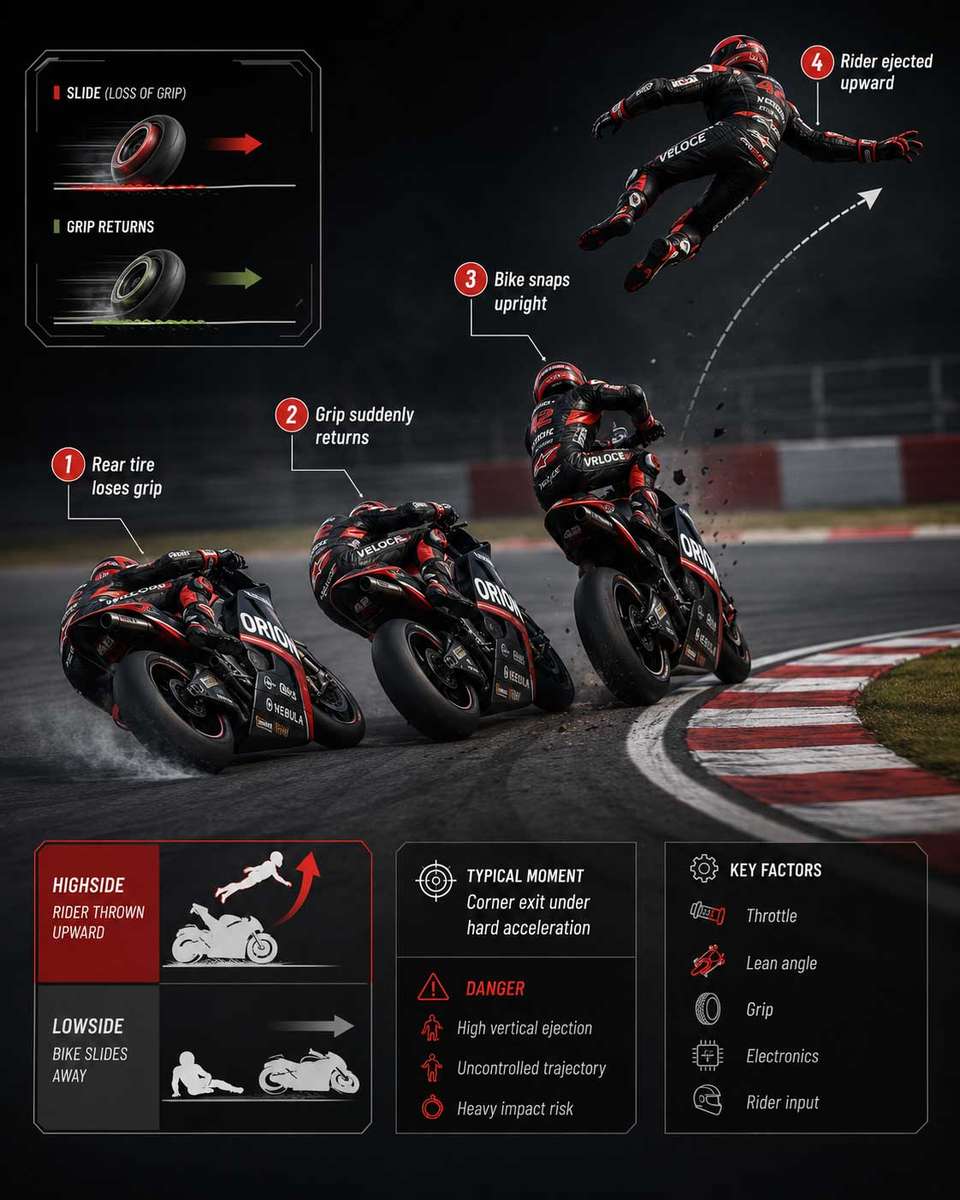
In MotoGP terms a highside occurs when the rear wheel momentarily loses traction—usually while the bike is leaning in a corner—and then suddenly regains traction. That abrupt change in lateral grip, often combined with suspension rebound, forces the chassis to rotate and can catapult the rider off the outer (high) side of the motorcycle.
HOW IT HAPPENS OR HOW IT WORKS
Fundamentally a highside is driven by the switch between sliding (kinetic friction) and rolling/gripping (static friction). While the rear tyre is sliding it has lower lateral grip. If conditions or inputs change so the tyre snaps back to a non-sliding condition, the tyre can instantly re-apply significant lateral force to a chassis that is unstable. That sudden lateral re-application combined with spring/damper rebound creates a rapid rotational moment that flips the bike upright and throws the rider.
Common triggers include abrupt throttle re-application or closure while leaned over, encountering a change in the grip patch (oil, dust, wet patches), or an aggressive corrective steering input during a slide. Suspension behaviour during rebound amplifies the rotational impulse when grip returns.
HIGH-SIDE VS LOW-SIDE
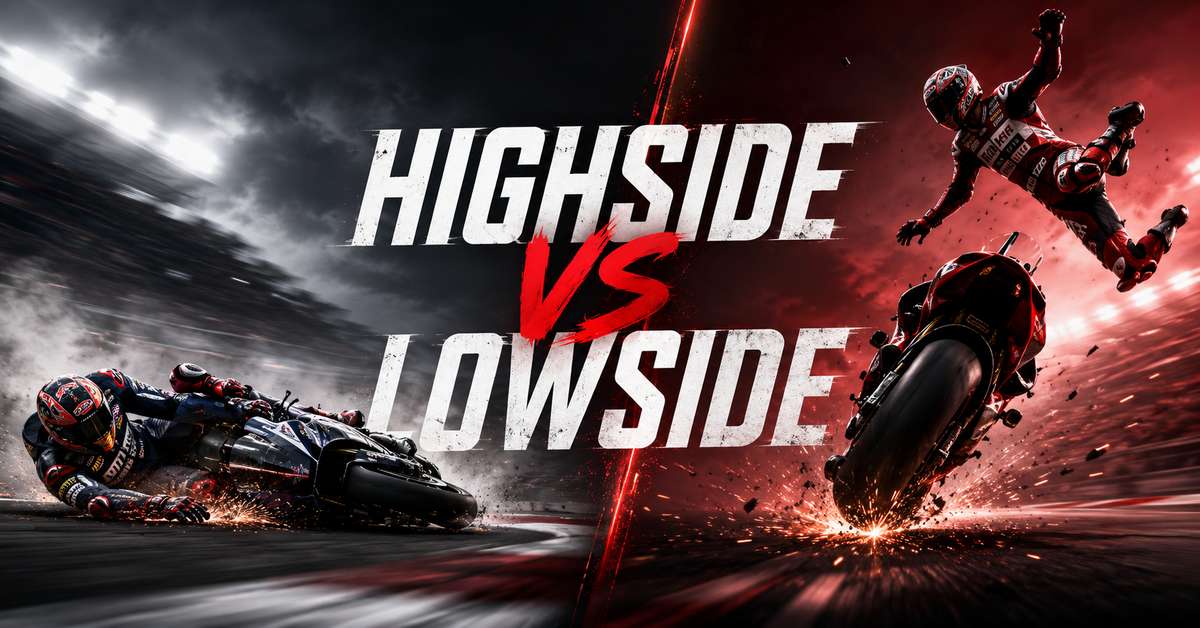
The contrast is straightforward and important for viewers. In a lowside the tyre loses grip and continues to slide: the bike and rider fall toward the inside of the corner and usually slide along the asphalt. In a highside the rear tyre initially slips but then suddenly regains traction; the bike snaps back, rotates, and ejects the rider upward or outward from the high side. Because of that violent ejection, highsides are typically more dangerous.
RIDER TECHNIQUE
Rider inputs strongly influence the risk of a highside. Smooth throttle modulation during corner exit and measured steering corrections keep the rear from transitioning abruptly from sliding to gripping. Sudden power application when the tyre is sliding or abrupt steering counter-actions increase the chance the slide will re-attach violently. Riders also use body position and subtle weight transfer to stabilise the chassis and reduce the likelihood of a violent regain of traction.
BIKE BEHAVIOUR AND TECHNOLOGY
From a bike perspective, tyres, suspension and electronics matter. A sliding tyre has less lateral grip than a rolling tyre; when it returns to rolling grip rapidly, the resulting force spike can be transmitted through the suspension and frame. Modern MotoGP systems—traction control, smoother power delivery electronics and suspension setup—reduce the probability that a slide will become a highside, but they cannot prevent highsides entirely when grip conditions or rider inputs exceed system limits.
SAFETY AND RISK
Highsides are generally more dangerous than lowsides. The violent ejection throws the rider off the bike, often upward or forward, increasing the risk of high-energy impacts with the track or obstacles; the bike itself can land on the rider. Medical studies and racing sources identify highsides as a common mechanism for severe injuries because of the forces involved and the unpredictability of the rider’s trajectory.
COMMON MISUNDERSTANDINGS
Beginners often assume all slides are the same. A useful distinction is that continued sliding produces a lowside, whereas a sudden recovery of grip produces a highside. Television footage can be misleading: a crash that looks like a mechanical flip may still be a grip-regain highside. Also, electronics and setup reduce risk but do not eliminate it—highsides still occur when physics and inputs overwhelm systems and rider control.
FAN VIEWING GUIDE
On-screen, watch the rear wheel and the bike’s attitude: if the rear steps out and the bike keeps sliding toward the inside, a lowside is more likely. If the rear steps out and then the bike suddenly snaps upright or the rider is thrown off the outer side, that is a highside. Understanding this helps fans interpret safety responses, medical flags and why riders may be taken off for checks after particularly violent ejections.
CLOSING INTERPRETATION
Highsides reveal the thin line MotoGP riders operate on between controlled slip and catastrophic grip re-attachment. They are a clear demonstration of how tyre physics (static vs kinetic friction), rider inputs, suspension dynamics and electronics interact under extreme conditions. For fans, recognising a highside makes a crash easier to read; for riders and teams, preventing one is a constant balance of technique, setup and electronic control.
Author: Eric M.