MotoGP Honda vs CBR: Technical Breaks from the RC213V Prototype to Road CBR…
The gap between Honda's MotoGP prototypes and its CBR road-series machines is not merely one of power and price: it is an engineering separation driven by different design constraints and intentions. The RC213V family (often referenced as RCV/RC213V) embodies a series of technical directions that exist to extract lap-time within MotoGP rules, while CBR models prioritise production constraints, emissions, durability and everyday usability.
Summary
The RC213V represents a purpose-built MotoGP machine: a V4 architecture, pneumatic-valve high‑RPM valvetrain, seamless gearbox and aggressive aero and chassis development. Road CBRs are production-oriented and therefore omit or adapt those race-specific technologies.
Reader preview
- Why Honda chose a V4 for its MotoGP prototype versus inline layouts on many CBRs.
- Which race technologies are incompatible with road production and how Honda adapted them for RC213V-S.
- How chassis, aero and electronics form an integrated prototype development culture distinct from CBR design priorities.
Quick access
What made the bike technically interesting
The RC213V's technical interest is rooted in its purpose: a machine optimised for MotoGP performance within the series' technical regulations. That intention drives choices that are rarely, if ever, practical for a production CBR. The combination of a V4 engine architecture, race-only valve systems, a seamless gearbox and a relentless aero and chassis test programme created a compact, high‑revving prototype where packaging, centre of gravity and transient behaviours were tuned for single‑lap and race pace rather than longevity or street usability.
In practice, this meant Honda engineers could prioritise peak power delivery, rapid directional changes and electronic control strategies that demand intensive maintenance and bespoke calibration — elements that contrast with the robustness and regulatory demands of CBR production bikes.
Powertrain or engineering identity
Perhaps the clearest mechanical divergence is the use of a V4 engine architecture in the RC213V. The V4 layout is purpose-designed for MotoGP: compact longitudinal packaging, torque delivery characteristics tuned for racing, and a centre of mass that supports aggressive chassis geometry. By contrast, many Honda CBR road models use inline-four engines, which are easier to package for production, simpler to service, and aligned with cost, emissions and durability targets.
Another decisive difference is valvetrain technology. RC213V race engines have historically used pneumatic valve actuation to allow extremely high engine speeds and reliable valve control at those revs. Pneumatic systems increase mechanical complexity and require intensive servicing — reasons why the road-legal RC213V-S replaces pneumatic valves with conventional coil valve springs. This substitution highlights a fundamental engineering tension: what is optimal for peak lap-time is often unsuitable for road durability and legal constraints.
Finally, the RC213V's gearbox solutions diverge from production practice. Seamless-shift technology used on the race machine reduces torque interruption during gear changes, improving acceleration and stability under hard load — advantages critical in racing but impractical to fit to standard CBR models or the RC213V-S road derivative, where a conventional gearbox is used to meet reliability and regulatory constraints.
Chassis and mechanical direction
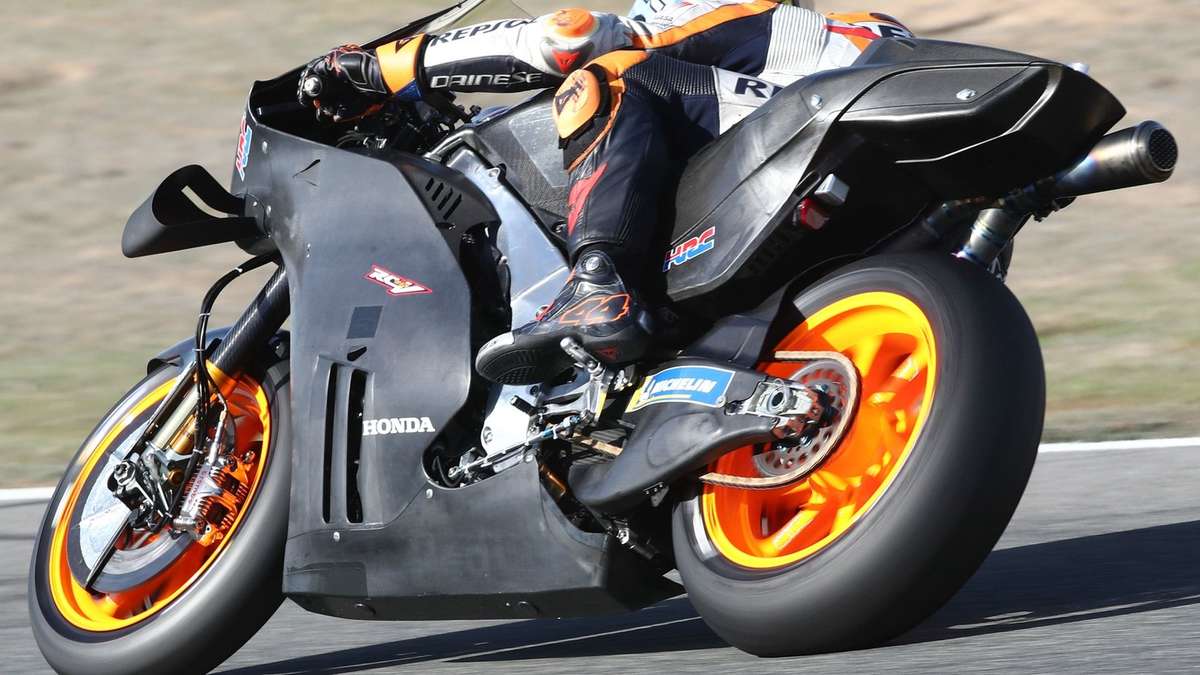
Honda's prototype programme experiments with mainframe constructions, swingarm designs and stiffness tuning as part of a continuous search for handling balance at race pace. RC213V iterations are notable for the variety of chassis set-ups tested: engineers trade stiffness, flex distribution and swingarm geometry to control traction, turning behaviour and braking composure at the edge.
These chassis experiments are meaningful to MotoGP because they influence how the bike manages tyre load, corner entry stability and mid-corner changes of direction. By contrast, CBR frames are engineered for consistent behaviour across many riders, long service life and predictable feedback, which limits the extent of radical stiffness manipulation or bespoke race-oriented material choices.
Aerodynamics and bodywork thinking
Aero has been a clear area of prototype focus on the RC213V. The use of winglets and evolving bodywork shapes is intended to manage aero load, reduce wheelie tendency on corner exit and improve high-speed stability. On a race bike, aerodynamic devices are tuned to offer specific front-end load or lift reduction targets that directly affect braking composure and launch performance.
For road machines like CBRs, aero must be reconciled with rider comfort, legal considerations and broad usability; therefore many of the aggressive aero solutions on the RC213V are either absent or heavily modified on production bikes. The RC213V-S, as a bridge between race and road, demonstrates how race aero must be adapted to comply with road-use requirements.
Control systems and electronic layer
MotoGP prototypes use highly sophisticated electronic systems — bespoke engine maps, traction control, wheelie control and launch strategies — developed for racing needs and adjusted continuously by the factory. These systems form an integral part of the RC213V's behaviour: electronics are tuned to extract performance from the V4 engine and the chassis/aero package, and to manage tyre behaviour under extreme loads.
Production CBR models include electronic aids too, but they are productised for reliability, user-friendliness and compliance. The engineering trade-off is clear: prototype electronics prioritise performance flexibility and are resource‑intensive to maintain; production electronics prioritise robustness and ease of use.
Development culture and factory direction
The RC213V programme reflects a development culture that operates with different constraints from mass-market motorcycle engineering. Within MotoGP rules, Honda can iterate rapidly on chassis, aero and engine concepts; this encourages experimental thinking and specialist solutions. The factory mindset is therefore oriented to pushing boundaries, accepting short development cycles and intensive maintenance — a contrast with the conservative cycles and economies of scale that govern CBR production engineering.
The RC213V-S project makes the distinction explicit: when transforming race technologies for limited road use, Honda deliberately omitted or modified race systems (pneumatic valves, seamless gearbox and other components) to address road reliability, emissions and usability requirements. That adaptation process documents which prototype ideas are practical to carry across and which are intrinsically race‑only.
Which ideas lasted
Not all prototype innovations transfer directly to production models, but the RC213V's intensive aero work and lessons about chassis stiffness distribution have informed broader engineering thinking. Where concepts proved to improve stability or tyre management without excessive cost or service burden, they filtered into later development philosophies. Conversely, technologies such as pneumatic valves and seamless gearboxes have remained largely within the race domain or adapted only in highly modified forms for limited-production specials like the RC213V-S, where concessions are necessary.
Why its innovation story still matters
Studying the RC213V against the CBR production line clarifies how different engineering priorities shape motorcycle design. The prototype teaches us about what peak-performance engineering values — compact V4 packaging, valvetrain choices for extreme revs, torque-continuous gear shifting, aggressive aero and experiment-led chassis tuning — and which of those values are incompatible with mass-market constraints. For engineers and technically curious fans, the RC213V remains a clear example of a factory culture that tests the limits of motorcycle performance and then highlights, through projects like RC213V-S, the compromises required to translate race ideas into road reality.
Author: Eric M.