Is it too late to become a MotoGP rider?
Short answer: not always — but "not too late" depends on what you mean by "become a MotoGP rider." Reaching MotoGP follows a defined ladder and is constrained by category age rules, the time needed to accumulate racing experience, and the financial and team support that makes progression possible.
The simple yes/no hides a complex reality: age matters for junior-category eligibility and how quickly you can acquire the specific racing experience teams expect. Read on to see what the question actually contains and which conditions turn possibility into probability.
Direct answer
It isn’t an absolute cutoff: MotoGP is the end of a ladder (miniGP/national → FIM JuniorGP/CEV → Moto3 → Moto2 → MotoGP). But category age limits, the time needed to climb that ladder, and the money or team backing you require mean that starting late narrows practical options.
What this article explains
- Why the defined ladder matters more than a single age.
- How FIM junior-category age caps shape opportunity windows.
- Which abilities and experience teams expect, and why they take time to build.
- How finances and seats narrow the pathway as you get older.
Racing a bike is not the same as reaching MotoGP
Many readers conflate learning to ride fast with following the feeder ladder to MotoGP. MotoGP is the pinnacle of Grand Prix motorcycle racing; riders typically progress through national or minibike categories, FIM JuniorGP or equivalent junior championships, then Moto3 and Moto2 before a MotoGP seat becomes realistic. Each step is competitive and specialised: doing well in club races is not the same credential as podiums in junior world series.
Age limits and eligibility reshape the timeline
The ladder includes junior categories that enforce maximum ages. For example, FIM JuniorGP sets a maximum age of 25 measured at 1 January of the championship year, while other junior categories (such as the European Talent Cup) may impose lower maximum ages (for instance, a maximum of 19 at 1 January). Those rules create windows where a rider can compete in the specific series that feed Moto3 and Moto2.
The abilities teams cannot ignore
Teams looking up the ladder evaluate more than raw wheel-to-wheel speed. They look for repeatability under race pressure, the ability to adapt across circuits and bike types, and race intelligence gathered from experience in the same categories that produce Moto3/Moto2 graduates. Acquiring those abilities typically requires seasons spent inside the feeder series not just occasional testing.
Why starting early changes the equation
Starting younger gives an advantage because early years allow riders to accumulate category-specific experience: understanding tyre behaviour, race starts, pack dynamics, and how to extract consistent lap time across a season. Because the ladder expects riders to arrive at each step already versed in those skills, late starters must compress that learning into fewer seasons — possible, but harder and often more expensive.
Money, support and the narrowing funnel
Progression toward MotoGP is expensive and frequently depends on sponsorship, team academies, or national federation support. Financial backing funds seasons of competition, tyres and consumables, travel, crash repairs and entry fees. Teams also provide seats selectively; a talented rider without funding or academy support will face fewer opportunities to race in the exact championships that lead to Moto3 and Moto2.
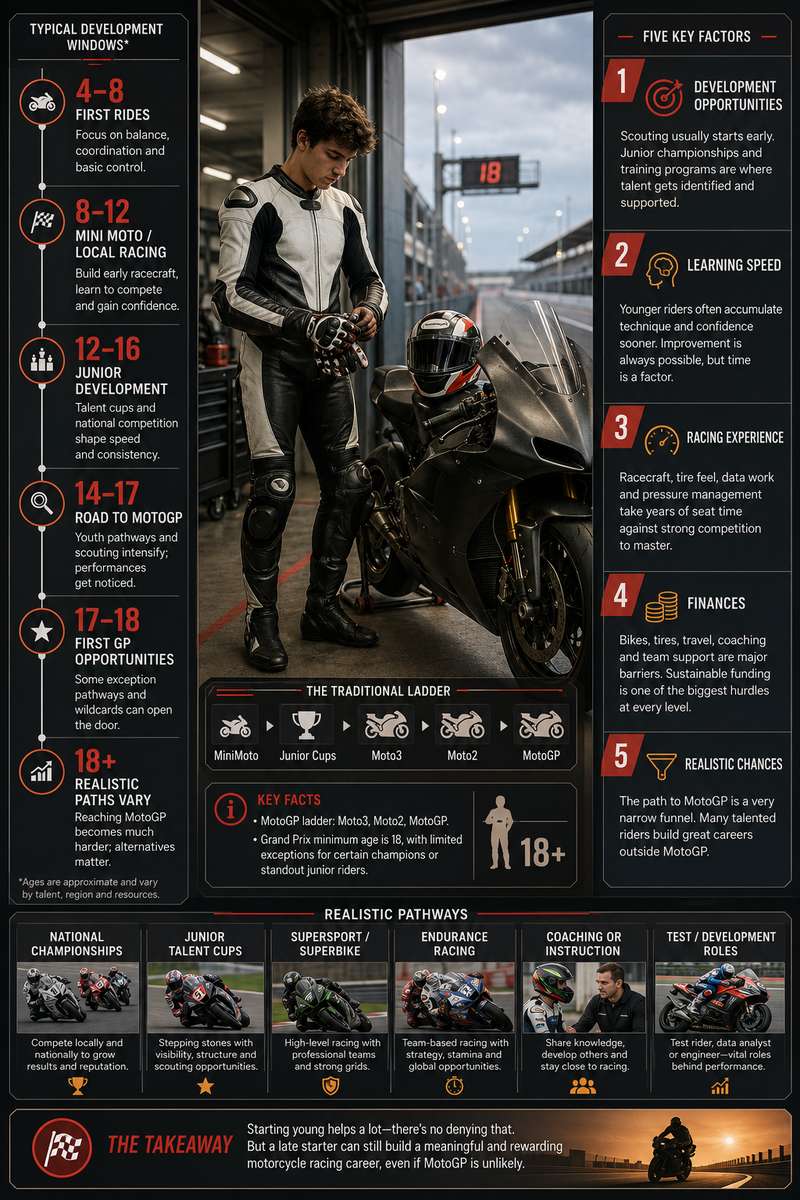
The development path: what climbing the ladder looks like
The practical route moves through distinct competitions: domestic minibike or national series, then FIM JuniorGP-level championships, then Moto3 and Moto2 before MotoGP. Each step is not only faster but more specialised; success in FIM junior championships is a common stepping stone for riders who debut in the premier class. Because the ladder is serial, late arrival compresses the time you have to learn and show results in the required series.
Grid age spread and real-world exceptions
MotoGP grids historically show a wide age spread: some riders race competitively into their late 30s or beyond, while modern rookies often arrive in their late teens or early 20s after success in junior world championships. This demonstrates two facts: age alone does not preclude competitiveness at the highest level, and the modern pattern favours riders who follow the feeder ladder earlier in life.
What a late starter can realistically aim for
If you begin later, the most realistic routes are to aim for professional racing careers that are not strictly MotoGP — strong national championships, endurance riding, or other professional categories — or to target exceptional, fast progression into junior world championships where age rules still permit. Success in those arenas can occasionally open doors to grand prix teams, but the path is narrower and requires quicker accumulation of feeder-series experience and likely stronger financial or academy backing.
What schools and academies can — and cannot — do
Racing schools and team academies help develop technique and provide exposure, but paying for instruction is not the same as earning a seat in a feeder championship. Academies and team programs can identify and support talent, but progression still depends on championship results, category eligibility, and available seats in the next step up the ladder.
The talent funnel: why many promising riders stall
The pathway narrows at each level. Limited seats in Moto3, Moto2 and then MotoGP mean that even excellent riders can be left without a step up. Eliminations happen for many reasons beyond speed: timing, funding, injuries and the availability of team seats. That narrowing is why early-category experience and exposure matter: they create the statistical weight that teams use when selecting rookies.
Practical next steps for serious late starters
If you are starting later but still serious, plan around three priorities: enter the feeder championships allowed by your age, secure funding or team backing early, and focus on rapid accumulation of race experience in the specific classes that lead toward Moto3/Moto2. Be realistic: the ladder is defined and time-sensitive, so measure progress against category eligibility rather than vague timelines.
Final verdict: possible but conditional
It is not categorically too late to become a MotoGP rider, but the answer is conditional. MotoGP sits at the end of a defined ladder that includes junior categories with maximum ages; modern rookies typically arrive younger after success in those series. Age does not alone banish possibility — the grids include older successful riders — yet starting late reduces the time available to build the category-specific experience teams expect and increases reliance on funding or academy support.
If your ambition is MotoGP, treat age as one constraint among several: use the ladder as your roadmap, verify which junior categories you can still enter, secure backing, and accept that alternative professional careers in other top-level series are realistic and valuable outcomes if MotoGP proves unreachable.
Author: Cynthia D.