Honda RCV 2022: a turning point in Honda’s MotoGP development philosophy
The Honda RC213V family arrived in MotoGP carrying the weight of Honda's long factory tradition: a fast, complex prototype shaped by aggressive engineering choices and a relentless search for lap-time. The 2022 specification — commonly referred to in paddock shorthand as the Honda RCV 2022 — is best read not as an isolated machine but as a visible hinge in the RC213V project's public story: a season where philosophy, rider needs and factory direction visibly clashed and began to recalibrate.
Summary
The RCV 2022 represents a concentrated moment in which Honda's long-standing approach to chassis balance, aero packaging and engine character was put under fresh pressure by changing rider expectations and a field evolving rapidly in electronics and aerodynamics. The season-spec bike exposed strategic tensions inside the factory project and helped trigger clearer shifts in development priorities.
What this article covers
- How the RC213V lineage arrived at the 2022 specification
- Why 2022 is a meaningful pivot rather than only a yearly update
- Which rider and technical pressures shaped subsequent development
Quick access
ORIGINS OF THE PROJECT
The RC213V story begins with Honda’s response to the new MotoGP rules that replaced the 990cc and 800cc eras: a pure factory prototype conceived to restore Honda’s template of high peak power married to precise tyre management. From its origins the RC213V family was a laboratory for aggressive engine mapping, compact packaging and chassis choices intended to extract maximum corner speed. Over several seasons that followed, Honda’s development rhythm favored powerful short-term gains — especially on fast circuits — and a continuing faith in the traditional Honda handling envelope.
EARLY IDENTITY
In its formative years the RC213V identity crystallised around certain constant themes: an engine tuned for strong drive, a chassis that demanded a committed rider style, and a sensitivity to front-end feel that often rewarded momentum and bravery. These traits delivered race-winning pace on circuits and in conditions that matched the bike’s strengths, but they also revealed a narrow effective window where the machine could be fully exploited. Riders who could find that window enjoyed laps at the front; those who couldn’t often struggled for consistency.
FIRST BREAKTHROUGHS OR EARLY LIMITS
As rivals advanced in aerodynamics and electronic integration, the RC213V alternated between breakthroughs and exposed limits. Incremental chassis refinements improved agility and stability, but the bike’s broad competitive picture began to show two trends: first, the paddock’s collective understanding of how to merge aero, electronics and tyre management advanced quickly; second, rider expectations shifted toward machines that offered wider usable grip and more predictable, less physically demanding behaviour. By the turn of the 2020s, the RC213V lineage still had top pace on its day, yet its operating window increasingly looked constrained relative to competitors who delivered more consistent behaviour across tracks and conditions.
RIDERS AND DEVELOPMENT ERAS
The RC213V’s story cannot be told without reference to the riders tasked with extracting its potential. Across its life, different rider eras emphasised different priorities: some demanded absolute peak performance and unforgiving responsiveness; others sought stable, confidence-inspiring feedback that enabled tyre care and race-long consistency. Those divergent needs placed real pressure on Honda’s development strategy. The 2022 specification sits within that negotiation — a moment when rider feedback, results pressure and the factory’s engineering instincts intersected in more visible tension than usual.
TECHNICAL AND STRATEGIC TURNING POINTS
The RCV 2022 should be seen through its technical and strategic inflection points rather than as a single set of components. In the seasons leading to 2022 the paddock emphasised integration: aerodynamic work became inseparable from chassis setup; electronics ceaselessly narrowed the gap between available performance and usable performance. For Honda, this required choices about where to invest finite resources: continue with a compact, high-strung engine and a chassis that rewarded aggressive riding, or shift to solutions that broadened the bike’s usable range.
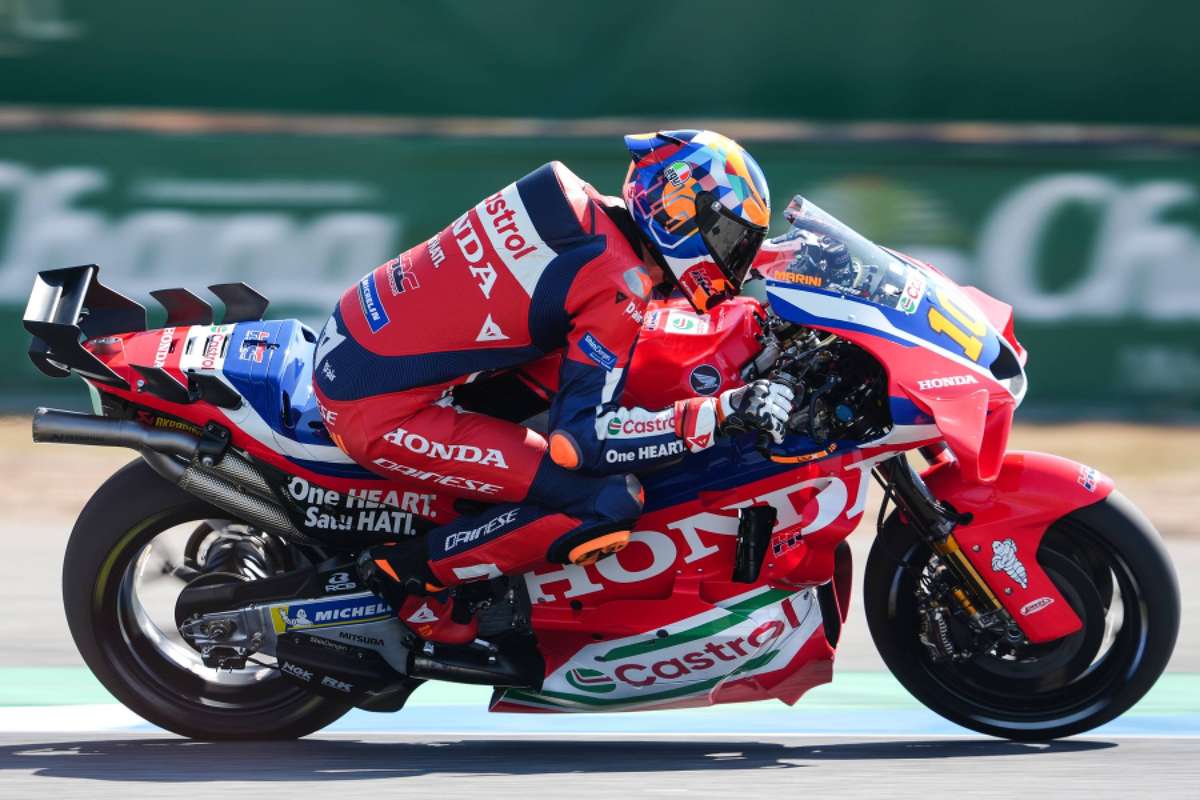
The 2022 specification revealed the start of that strategic re-evaluation. Packaging and aero around the front of the bike looked to improve front-end feel; suspension geometry and frame stiffness were studied with an eye to making the bike less temperamental on entry and more controllable across tyre life. These were evolutionary moves, but collectively they signaled a change in priorities — from chasing peak lap time at the cost of a narrow handling window, to searching for a steadier baseline that delivered more consistent race results.
COMPETITIVE HIGHS AND LOWS
The 2022 RC213V did not rewrite the record books overnight. Instead, it exposed the dual nature of Honda’s project: on certain circuits the bike still showed flashes of class-leading performance; on others the limitations in front-end confidence and tyre management produced visible shortfalls. Those highs and lows made the season an informative one for engineers and management. Where the bike performed it validated the core strengths of the RC213V lineage; where it faltered it provided blunt feedback about what needed to change: a broader handling envelope, clearer integration of aero and electronics, and rider-focused setup flexibility.
THE BIKE IN THE WIDER MOTOGP CONTEXT
Viewed against the broader MotoGP landscape, the 2022 machine is an example of how legacy projects must confront accelerating change. Competitors had begun to reap the rewards of a closer alignment between aerodynamic philosophy, electronic strategy and chassis balance. The RCV 2022 made plain that Honda’s future competitiveness would depend on bridging a conceptual gap: retaining the RC213V’s traditional strengths while making the package more usable across a wider spectrum of riders, tyres and circuits. In other words, the bike’s history at that point was as much about adaptation as it was about performance alone.
WHAT ITS HISTORY NOW MEANS
Historically, the RCV 2022 occupies the role of pivot rather than terminus. It is the specification that underlined a choice facing Honda: double down on the factory’s established character and risk narrowing the competitive window further, or reorient development toward predictability, rider confidence and integrated solutions. The season served as a diagnostic year — a concentrated set of lessons that reshaped subsequent development priorities and resource allocation.
That position makes the RCV 2022 important to historians of the sport. It marks the moment where short-term race-spec adjustments no longer sufficed; what was required was a re-articulation of design philosophy across engine character, chassis geometry and aerodynamic packaging to meet the new demands of MotoGP. The machine’s story is therefore not merely one of parts changed or a list of results, but of a factory confronting the limits of an inherited approach and beginning a deliberate pivot.
CONCLUSION
The Honda RCV 2022 is significant because it pulled into focus the tension between tradition and adaptation in a top-level factory MotoGP project. It made visible the choices Honda faced about rider priorities, integration of aero and electronics, and the nature of competitiveness in a rapidly evolving field. As such, the 2022 specification reads as a turning point — a learning season that informed a clearer strategic direction for the RC213V lineage in the seasons that followed.
Author: Eric M.