Fabio Quartararo Honda: Reading the rider's revised style and what it means…
Fabio Quartararo has openly described a deliberate revision of his riding style during 2024–2025, using the word "SMOOTH" as a visible reminder during tests. This piece examines the observable, defensible technical traits of that change and places them against the known demands of Honda machinery, drawing on public statements, test reports and race context.
Quick summary: Quartararo has consciously sought to smooth aspects of his technique in 2024–2025. Journalists and official analysis note how inline-four Yamaha and V4 Honda platforms require different riding emphases; his confirmed signing with Honda Racing Corporation makes this stylistic shift a practical preparation as well as a tactical evolution.
FIRST TECHNICAL READING OF THE RIDER
The most concrete starting point is Quartararo's own description of a conscious change: across tests and race weekends in 2024–2025 he said he had "completely changed" aspects of his riding and even displayed "SMOOTH" on his dash as a reminder during the 2025 Sepang test. That combination of public comment and a visible dashboard prompt is a rare direct admission that technique — not only setup — was being altered deliberately.
This is important because it frames observable behaviours as intentional adjustments. Reporters who tracked his test pace and comments describe a movement away from sharper, more aggressive inputs toward a smoother, more controlled approach; that is the working baseline for any technical reading of his riding during this period.
BRAKING AND CORNER ENTRY
Sources note Quartararo's effort to modify how he approaches corners. The public commentary around his technique change implies an emphasis on moderating inputs: braking application that is steadier and a corner-entry posture less reliant on late, aggressive commitment. Journalists have contrasted these tendencies with the demands typical of different chassis architectures.
While on-board telemetry is not publicly available in the cited material, the qualitative evidence — rider statements and test behaviour reported by analysts — supports a defensible claim: the rider has aimed to reduce abruptness at entry, trading acute braking violence for a more progressive deceleration to align with a refined rhythm.
MID-CORNER AND LINE CHOICE
Where Quartararo’s revision shows through is in mid-corner control and line discipline. Observers and technical features note a rebalancing toward preserving corner exit by smoothing throttle and chassis inputs through the middle of the turn. The editorial coverage that verifies his shift ties this to lap consistency and tyre use rather than speculative setup details.
This behaviour is consistent with a rider trying to protect rear traction and build exit stability: choosing lines that allow a progressive roll-on and avoiding maximal lean-angle gambles that can cost rear grip later in a stint.
EXIT TRACTION AND TYRE MANAGEMENT
Public analysis and race reports during the period link Quartararo’s stylistic change with a focus on tyre management and exit traction. The narrative in verified coverage suggests he aimed to generate smoother throttle transitions to preserve the rear tyre over race distance.
That interpretation fits the rider’s stated motives: smoothing inputs to reduce tyre spikes and create a more sustainable race pace. The available sources emphasise this as a tactical choice rather than a technical dossier on exact tyre-life metrics.
ADAPTATION TO BIKE, TYRES, OR CONDITIONS — WHY IT MATTERS FOR HONDA
Multiple reputable outlets and MotoGP analysis materials underline that Yamaha inline-four and Honda V4 platforms present different characteristics for riders. These differences have real implications for braking, corner speed and acceleration balance. Quartararo’s signed move to Honda Racing Corporation (HRC) is confirmed by Honda and independent reports, so his public work on adapting and smoothing his technique takes on additional context as preparation for a different machine architecture.
Journalists have noted that a V4-based Honda can demand changes in how a rider manages power delivery and transitional phases. Given Quartararo’s own statements about revising his riding, his smoothing programme can be read as a practical attempt to align his natural tendencies with the technical profile he will face at HRC.
RACECRAFT, QUALIFYING PROFILE AND RACE CONTEXT
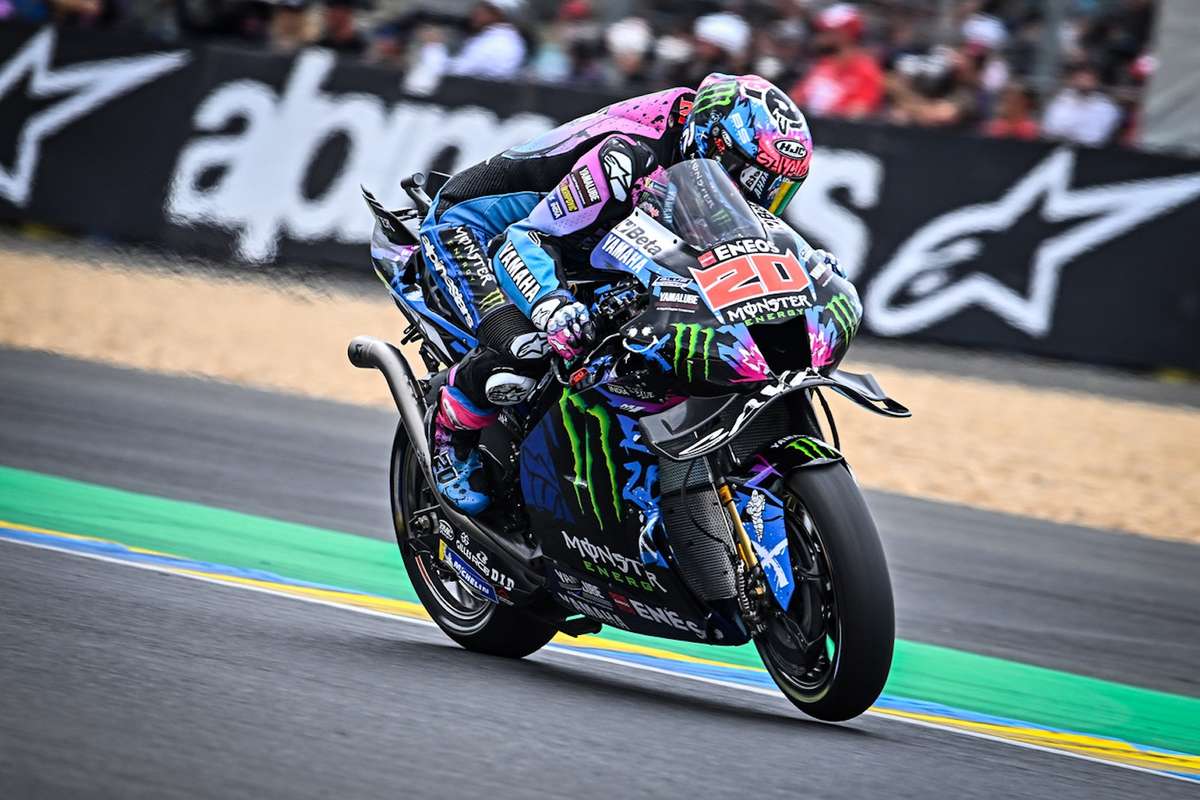
Verified race reports and analysis from the 2024–2025 period show Quartararo remained an active competitor in practice and qualifying sessions, and that the stylistic changes occurred alongside normal race pressures. The Le Mans 2025 weekend is part of that context: he was competitive in practice/qualifying but suffered a crash in the race, a fact established in official coverage and race reports.
From an analytical standpoint, a rider smoothing his technique often aims to gain consistency across qualifying runs and race distance. The sources corroborate the narrative of a rider balancing one-lap speed with a renewed focus on sustainable race performance rather than radical single-lap extraction only.
HARD FACTS AND DEFENSIBLE CLUES
Stick to the verified anchors: Quartararo publicly said he revised his riding style in 2024–2025 and used a dash prompt "SMOOTH" at Sepang 2025; journalists and MotoGP technical analysis contrast Yamaha and Honda machine demands; and Honda Racing Corporation has formally signed Quartararo for upcoming seasons. These are the documented touchpoints that allow us to interpret his technique change as both a performance choice and a preparatory step for a different bike architecture.
Absent telemetry or private engineering data, analysis must remain qualitative: the rider has shifted toward smoother inputs, likely to protect tyres and improve exit stability, and this aligns logically with adapting to a V4 Honda platform that asks for slightly different braking and acceleration behaviours.
CLOSING INTERPRETATION
Fabio Quartararo’s public decision to change his riding style—explicitly reminding himself to be "SMOOTH"—is a rare, confirmable window into a top rider’s technical evolution. With an official move to HRC confirmed, that evolution reads as both a performance optimisation and necessary adaptation to a new machine architecture. The available, verified evidence supports a cautious but clear conclusion: Quartararo is reworking his inputs toward steadier braking, gentler mid-corner transitions and more progressive exits—traits that make practical sense for riding a Honda V4 and for managing tyre life over a race.
Author: Cynthia D.